

Windows stores user environment variables in our own profile, so we can set environment variables without admin access by creating them as user variables instead of system variables. Only system variables, which apply to every account on the machine, need administrator rights.
We need user variables on locked-down company laptops, where IT controls the system settings but we still have to point JAVA_HOME at a JDK, add Maven to Path or set a proxy for a build tool.
The following example sets JAVA_HOME and adds the JDK to the user Path from a normal PowerShell window, with no elevation.
[Environment]::SetEnvironmentVariable('JAVA_HOME', "$env:USERPROFILE\tools\jdk-25", 'User')
$userPath = [Environment]::GetEnvironmentVariable('Path', 'User')
[Environment]::SetEnvironmentVariable('Path', "$env:USERPROFILE\tools\jdk-25\bin;$userPath", 'User')

# open a NEW terminal, then check
echo $env:JAVA_HOME      # C:\Users\lokesh\tools\jdk-25
java -version            # openjdk version "25.0.x" ...
Notice that the new values appear only in terminals opened after the change. We look at where Windows keeps the two kinds of variables, the dialog that opens without admin rights, the setx command and its traps, and the Path order problem that hides a newer JDK.
1. User Variables vs System Variables
Windows builds the environment of every new process from two lists. System variables live in a machine-wide registry key that only administrators can write. User variables live under HKEY_CURRENT_USER, the registry part that belongs to the signed-in account, so a standard user can write them freely.
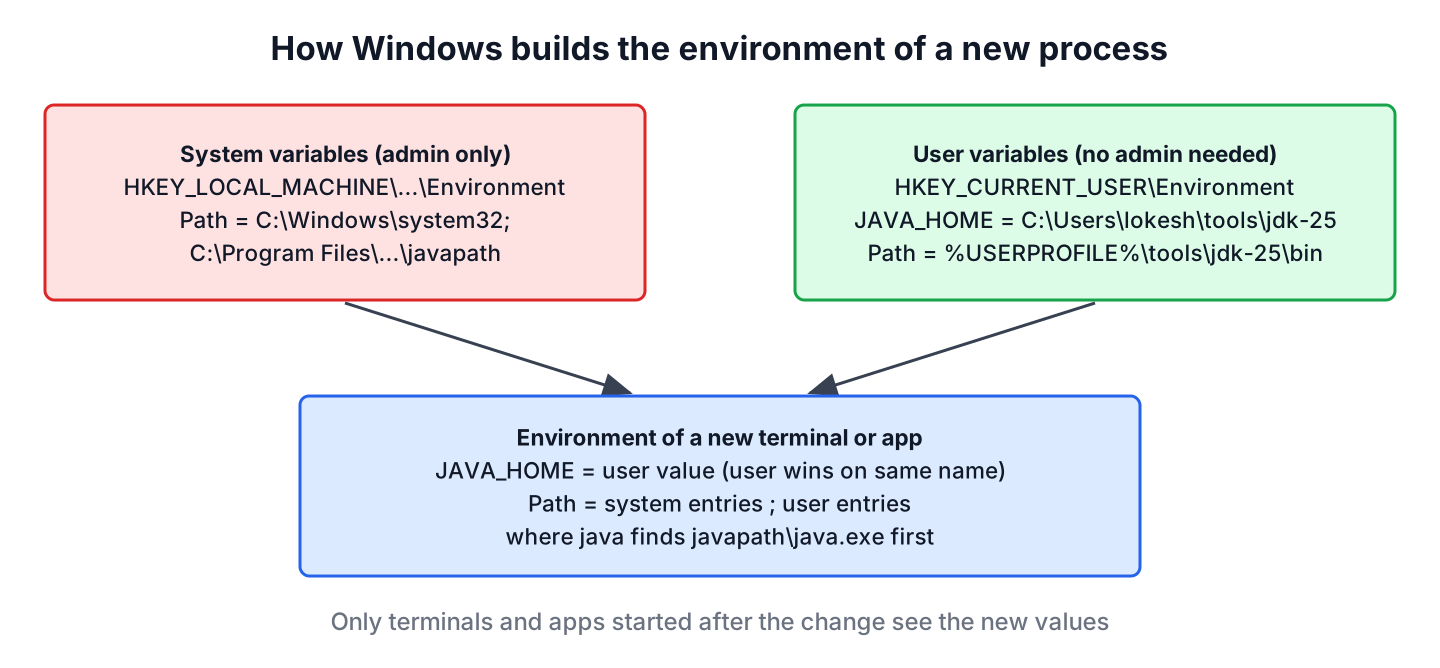
When a variable exists in both lists, the user value wins, with one exception. For Path, Windows joins the two lists, system entries first and user entries after them.
| User variables | System variables | |
|---|---|---|
| Registry key | HKEY_CURRENT_USER\Environment | HKEY_LOCAL_MACHINE\SYSTEM\CurrentControlSet\Control\Session Manager\Environment |
| Admin rights needed | No | Yes |
| Who sees the value | Only our account | Every account on the machine |
| Same name in both lists | User value is used | Overridden by the user value |
| Path | Appended after the system Path | Comes first |
Say a bank gives developers laptops with JDK 17 installed by IT, and a new project needs Java 25. We unzip the JDK into %USERPROFILE%\tools, which needs no admin rights, and set user variables for it. The system JDK stays untouched for other apps.
2. Editing Environment Variables Without Admin in the Account Dialog
The usual route through System Properties, Advanced and Environment Variables asks for administrator credentials on many company laptops. Even when a colleague types an admin password there, the dialog runs as that admin account, so its user list belongs to the admin, not to us.
Windows has a separate entry point that edits only our own variables and never asks for elevation. Any of these routes opens it.
- In Windows 11 or 10, open Start, type environment and pick Edit environment variables for your account.
- Press Win + R and run rundll32 sysdm.cpl,EditEnvironmentVariables, which opens the same dialog by command.
- In Control Panel, open User Accounts, User Accounts again, and select Change my environment variables in the left pane.
In the dialog, the upper list holds our user variables. We add JAVA_HOME with New, and to change Path, we select it, click Edit and add one folder per line with New. If the user list has no Path yet, we create one with that name. The lower system list stays read-only for a standard account.
3. Setting User Variables With setx
The setx command writes a variable to the registry from Command Prompt. Without the /m switch it writes a user variable, so it works in a normal window. With /m it writes a system variable and needs an elevated prompt.
setx JAVA_HOME "%USERPROFILE%\tools\jdk-25"
setx MAVEN_OPTS "-Xmx1g"

:: setx does not change the current window; open a new one to see the values
echo %JAVA_HOME%
Never run setx PATH “%PATH%;C:\new\folder” to extend the path. The %PATH% in that command is the merged path of the current window, so it copies every system entry into the user Path. The setx command also cuts values longer than 1,024 characters, and a long merged path loses its last entries.
Another catch is that Command Prompt expands variable references before setx runs. After setx PATH “%JAVA_HOME%\bin”, the registry holds the folder path, not the reference, so changing JAVA_HOME later does not change Path. The PowerShell method in the next section or the dialog is safer for Path.
To remove a user variable, we delete its registry value. The key belongs to our account, so this also needs no admin rights.
reg delete HKCU\Environment /v MAVEN_OPTS /f4. Setting User Variables With PowerShell
PowerShell calls the .NET method [Environment]::SetEnvironmentVariable(), and its third argument picks the scope. The User target writes to our own registry key and notifies running programs such as Explorer, so the method needs no admin rights.
# read the user Path only (not the merged one)
$userPath = [Environment]::GetEnvironmentVariable('Path', 'User')

# add Maven after the JDK, keep the old user entries
[Environment]::SetEnvironmentVariable('Path', "$userPath;$env:USERPROFILE\tools\maven\bin", 'User')

# delete a user variable
[Environment]::SetEnvironmentVariable('MAVEN_OPTS', $null, 'User')

# current window only, gone when the window closes
$env:JAVA_HOME = "$env:USERPROFILE\tools\jdk-25"
Reading the User value first is what keeps the system entries out of the user Path. PowerShell replaces $env:USERPROFILE with the folder path before the call, so the registry gets a fixed path. The method also stores the value as a plain string, so a %JAVA_HOME% reference written here would not be expanded later. We write folder paths in full for that reason.
| Method | Admin needed | Affects current window | Main risk |
|---|---|---|---|
| Dialog for your account | No | No, new windows only | None |
| setx NAME value | No | No | 1,024-character limit, expands %VAR% |
| setx NAME value /m | Yes | No | Writes for every account |
| [Environment]::SetEnvironmentVariable(…, ‘User’) | No | No | None if we read the user Path first |
| set NAME=value or $env:NAME | No | Yes, only that window | Lost when the window closes |
5. Setting JAVA_HOME and Path for Java
Java tools read two things. Maven, Gradle and most IDE launchers look for the JDK in JAVA_HOME, while typing java in a terminal uses the first java.exe that Windows finds in Path. The Java installation guide and the Maven setup on Windows use the same two variables.
- Unzip the JDK into a folder we own, such as %USERPROFILE%\tools\jdk-25.
- Set the user variable JAVA_HOME to that folder, without \bin at the end.
- Add %USERPROFILE%\tools\jdk-25\bin to the user Path.
- Open a new terminal and run where java and java -version.
The where java command lists every java.exe in Path order. If the first line is a system folder such as C:\Program Files\Common Files\Oracle\Java\javapath, the system JDK wins, because system Path entries come before ours and only an administrator can reorder them.
C:\> where java
C:\Program Files\Common Files\Oracle\Java\javapath\java.exe
C:\Users\lokesh\tools\jdk-25\bin\java.exe
We have three workarounds without admin rights. Build tools that read JAVA_HOME already use our JDK, IDEs let us pick the JDK per project, and for the terminal we prepend our JDK in the current window or in a small script that we run first.
:: java25.cmd in a folder on the user Path
set "PATH=%JAVA_HOME%\bin;%PATH%"
java -version
A running Java program can confirm what it received. The method System.getenv() returns the environment that the process got at startup, and the system property java.home names the JDK that runs the code, which can differ from JAVA_HOME.
String javaHome = Optional.ofNullable(System.getenv("JAVA_HOME")).orElse("not set");   // C:\Users\lokesh\tools\jdk-25 on our laptop
String runtime = System.getProperty("java.home");                                         // folder of the JDK running this code
6. Environment Variables for Child Processes in Java
A Java program cannot change its own environment or write user variables. The map from System.getenv() is unmodifiable, so a put() call throws UnsupportedOperationException.
Map<String, String> current = System.getenv();
String added = current.put("APP_MODE", "dev");          // UnsupportedOperationException
For a process that our program starts, such as a Maven build from a deployment tool, ProcessBuilder.environment() returns a modifiable copy. Changes there apply only to the child process.
ProcessBuilder builder = new ProcessBuilder("mvn", "-v");
Map<String, String> env = builder.environment();
env.put("JAVA_HOME", "C:\\Users\\lokesh\\tools\\jdk-25");
String childJavaHome = env.get("JAVA_HOME");            // "C:\Users\lokesh\tools\jdk-25"
boolean parentUnchanged = !"C:\\Users\\lokesh\\tools\\jdk-25".equals(System.getenv("JAVA_HOME"));   // true
To change user variables permanently from Java, the program would have to run setx or PowerShell as a child process, which is rarely a good idea. A setup script in the project repository is easier to review.
7. Windows Environment Variable FAQs
Locked-down laptops raise the same handful of questions, mostly about why a change does not show up.
7.1. Do I need to restart Windows after setting a user variable?
No. New terminals and apps started from Explorer get the new value right away. Programs that were already running keep the old environment, and so do terminals opened from inside them, such as the terminal tab of an open IDE. Restart the IDE, or sign out and in when an app still shows the old value.
7.2. Why does java -version still show the old Java version?
Because a system Path entry with another java.exe comes before our user entry. Run where java to see the order, as shown in section 5, and use JAVA_HOME-aware tools or a script that prepends our JDK.
7.3. Can a standard user change system environment variables?
No. System variables are stored in HKEY_LOCAL_MACHINE, which only administrators can write. A user variable with the same name overrides a system variable for our account, except for Path, which is merged.
7.4. Where are user environment variables stored?
In the registry under HKEY_CURRENT_USER\Environment. The command reg query HKCU\Environment lists them without opening any dialog.
7.5. How do I set a proxy for Maven without admin rights?
Set it in the user settings.xml of Maven, or as user variables such as MAVEN_OPTS. The Maven proxy settings article shows the settings.xml entries.
8. Conclusion
Windows keeps user variables in our own registry key, so we set JAVA_HOME, Path and tool options without admin access through the dialog for our account, setx without /m, or PowerShell with the User target.
Two traps remain. The command setx PATH “%PATH%;…” copies system entries and cuts long values, and system Path entries always come before ours. Reading the user Path first and checking with where java avoids both, and from Java, ProcessBuilder.environment() sets variables for child processes only.
9. References
- Microsoft, setx command
- Microsoft, Environment.SetEnvironmentVariable
- System.getenv() Javadoc
- ProcessBuilder Javadoc
Happy Learning !!
