
Learn to use @RestClientTest annotation provided by Spring boot test module that focuses only on beans that use RestTemplateBuilder or RestTemplate.
1. @RestClientTest annotation
In spring framework, @RestClientTest is one of the test specific annotations that disables full auto-configuration and instead apply only configuration relevant to specific tests.
@RestClientTest annotation is used to test service layer which uses RestTemplate to interact with external services.
This annotation disables full auto-configuration and instead apply only configuration relevant to rest client tests.
To import the annotation in application, include spring-boot-starter-test starter module into pom.xml file.
<dependency>
    <groupId>org.springframework.boot</groupId>
    <artifactId>spring-boot-starter-test</artifactId>
    <scope>test</scope>
</dependency>
2. Testing service which uses RestTemplateBuilder
If the service under test uses RestTemplateBuilder to obtain the RestTemplate for invoking external services, we can use @RestClientTest annotation directly over test class.
2.1. Service
import org.springframework.boot.web.client.RestTemplateBuilder;
import org.springframework.stereotype.Service;
import org.springframework.web.client.RestTemplate;
import com.springexamples.demo.service.UserService;

@Service
public class UserServiceImpl implements UserService {

    RestTemplate restTemplate;

	@Autowired
	public UserServiceImpl(RestTemplateBuilder restTemplateBuilder) {
        restTemplate = restTemplateBuilder.build();
    }

	@Override
	public String testUserService() {

		final String uri = "http://localhost:8080/users";

        String result = restTemplate.getForObject(uri, String.class);

        System.out.println(result);

        return result;
	}
}
2.2. Test class
import static org.assertj.core.api.Assertions.assertThat;
import static org.springframework.test.web.client.match.MockRestRequestMatchers.requestTo;
import static org.springframework.test.web.client.response.MockRestResponseCreators.withSuccess;
import org.junit.Test;
import org.junit.runner.RunWith;
import org.springframework.beans.factory.annotation.Autowired;
import org.springframework.boot.test.autoconfigure.web.client.RestClientTest;
import org.springframework.http.MediaType;
import org.springframework.test.context.junit4.SpringRunner;
import org.springframework.test.web.client.MockRestServiceServer;
import com.springexamples.demo.service.UserService;
import com.springexamples.demo.service.impl.UserServiceImpl;

@RunWith(SpringRunner.class)
@RestClientTest(UserServiceImpl.class)
public class UserServiceTest
{
	@Autowired
	private MockRestServiceServer server;

	@Autowired
	private UserService client;

	@Test
	public void testServiceCall()
	{
		this.server.expect(requestTo("http://localhost:8080/users"))
					.andRespond(withSuccess("<users></users>", MediaType.TEXT_PLAIN));

		String userServiceResponse = client.testUserService();

		assertThat(userServiceResponse).isEqualTo("<users></users>");
	}
}
3. Testing service which DOES NOT use RestTemplateBuilder
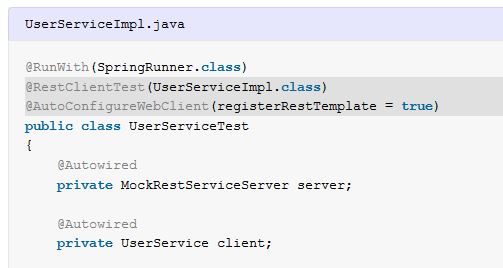
If the service uner test injects a RestTemplate directly, we can can add @AutoConfigureWebClient(registerRestTemplate=true) over test class.
Also, if you are creating RestTemplate bean in main application configuration then you will need to enable bean overriding to true.
spring.main.allow-bean-definition-overriding=true
2.1. Service
import org.springframework.beans.factory.annotation.Autowired;
import org.springframework.stereotype.Service;
import org.springframework.web.client.RestTemplate;
import com.springexamples.demo.service.UserService;

@Service
public class UserServiceImpl implements UserService {

	@Autowired
    RestTemplate restTemplate;

	@Override
	public String testUserService() {

		final String uri = "http://localhost:8080/users";

        String result = restTemplate.getForObject(uri, String.class);

        System.out.println(result);

        return result;
	}
}
2.2. Test class
@RunWith(SpringRunner.class)
@RestClientTest(UserServiceImpl.class)
@AutoConfigureWebClient(registerRestTemplate = true)
public class UserServiceTest
{
	@Autowired
	private MockRestServiceServer server;

	@Autowired
	private UserService client;

	@Test
	public void testServiceCall()
	{
		this.server.expect(requestTo("http://localhost:8080/users"))
					.andRespond(withSuccess("<users></users>", MediaType.TEXT_PLAIN));

		String userServiceResponse = client.testUserService();

		assertThat(userServiceResponse).isEqualTo("<users></users>");
	}
}
Drop me your questions related to Spring Boot @RestClientTest annotation as discussed above.
Happy Learning !!

Comments