Java Executors.newVirtualThreadPerTaskExecutor() Example
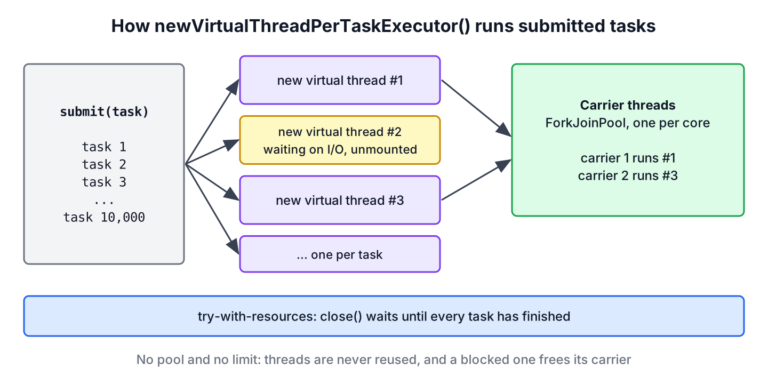
Executors.newVirtualThreadPerTaskExecutor() runs each task in a new virtual thread. Learn close(), invokeAll, Semaphore limits, thread names and errors.

Executors.newVirtualThreadPerTaskExecutor() runs each task in a new virtual thread. Learn close(), invokeAll, Semaphore limits, thread names and errors.
Java wait for all threads to finish with ExecutorService close(), invokeAll(), Future.get(), CountDownLatch, CompletableFuture.allOf() and join().
Shut down a Java ExecutorService with shutdown(), awaitTermination() and shutdownNow(), or with try-with-resources and close() on Java 19+. Covers queued tasks, RejectedExecutionException, virtual threads, JVM exit and shutdown hooks.
Learn to cancel a task in ExecutorService with Future.cancel(), stop running tasks with interrupts, cancel after a timeout and clean up with purge().
Java ScheduledExecutorService examples for delayed and periodic tasks, scheduleAtFixedRate vs scheduleWithFixedDelay, exceptions, cancel and daily jobs.
Learn how ExecutorService invokeAll() runs a batch of Callable tasks, with timeouts, failed tasks, Future.state() and invokeAny() for the first result.
A RejectedExecutionHandler decides what happens to a task that a ThreadPoolExecutor cannot accept. Compare the four built-in policies with real output and write custom handlers.
Learn ExecutorService in Java with Java 25 examples for submit(), invokeAll(), Future results, close() with try-with-resources and virtual threads.
Java thread pool guide with Executors factory pools, a fixed size pool example, ThreadPoolExecutor settings, pool sizing, monitoring and virtual threads.
See how the ThreadPoolExecutor BlockingQueue decides when the pool grows, with SynchronousQueue, bounded and priority queues, sizing and rejected tasks.
HowToDoInJava provides tutorials and how-to guides on Java and related technologies.
It also shares the best practices, algorithms & solutions and frequently asked interview questions.