@GetMapping and @PostMapping in Spring Boot (Examples)
@GetMapping maps HTTP GET requests and @PostMapping maps HTTP POST requests to controller methods in Spring. Both are shortcuts for @RequestMapping with a fixed HTTP method.

@GetMapping maps HTTP GET requests and @PostMapping maps HTTP POST requests to controller methods in Spring. Both are shortcuts for @RequestMapping with a fixed HTTP method.
Spring Boot @Autowired connects the classes together without tight coupling, making application modular, testable, and easy to maintain.
Learn about Spring @PathVariable and @RequestParam annotations and compare them with Jakarta’s @PathParam and @QueryParam annotations.
Spring boot @Repository annotation is a specialization of the @Component to indicate a data repository used for storage, retrieval, and search behavior.
Learn to unit test Spring Boot webflux controller using @WebFluxTest and WebTestClient, which is used to test reactive endpoints with JUnit.
At a high level, @RestController is a convenient annotation for writing REST APIs and combines @Controller and @ResponseBody annotations.
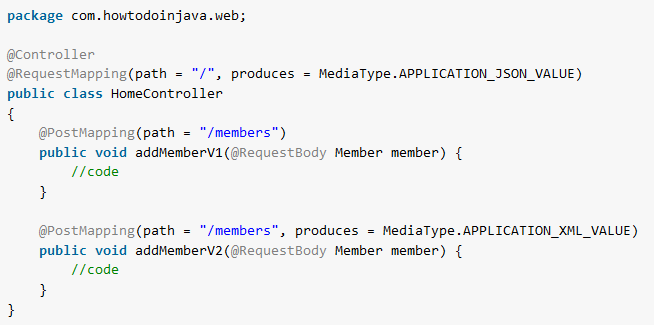
In Spring, @GetMapping maps HTTP GET requests and @PostMapping maps HTTP POST requests to controller methods. Both are shortcuts for @RequestMapping with a fixed HTTP method. See a working Spring Boot REST controller, the @RequestMapping equivalent and the attributes that narrow a mapping.
Spring @RequestMapping annotation, part of Spring MVC module, is used for mapping HTTP requests to handler methods in the @Controller classes.
Learn about spring bean stereotype annotations i.e. @Controller, @Component, @Repository and @Service, their real-life usages and examples.
Learn the main differences between tags <context:annotation-config> and <context:component-scan> in Spring MVC applications so that when we use them in the future, we will know, what exactly we are doing. 1. The Differences between <context:annotation-config> vs <context:component-scan> The first big difference between both tags is that <context:annotation-config> is used to …
HowToDoInJava provides tutorials and how-to guides on Java and related technologies.
It also shares the best practices, algorithms & solutions and frequently asked interview questions.