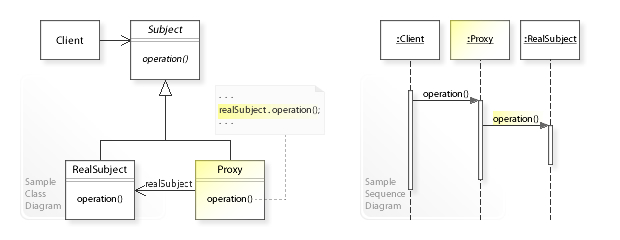
Proxy Design Pattern in Java
Learn the Proxy pattern in Java with a runnable lazy report example. See when loading occurs, how repeated reads behave, and the limits of caching and concurrency.

Structural design patterns show you how to glue different pieces of a system together in a flexible and extensible fashion. They help you guarantee that when one of the parts changes, the entire structure does not need to change.
These patterns focus on, how the classes inherit from each other and how they are composed from other classes. Structural patterns use inheritance to compose interface or implementations. Structural object patterns describe ways to compose objects to realize new functionality
Learn the Proxy pattern in Java with a runnable lazy report example. See when loading occurs, how repeated reads behave, and the limits of caching and concurrency.
Learn the Flyweight design pattern in Java with a runnable pen factory example. See what state to share, how the cache key works, and when reuse is worthwhile.
Learn the Facade design pattern with a runnable Java report example, clear UML diagrams, and practical guidance on file errors and subsystem access.
Learn the Composite design pattern with a runnable Java portfolio example. See how leaf and group objects share one operation, and how duplicate membership and overflow affect totals.
Learn the Bridge pattern in Java with a runnable report example. See how report types and output formats vary independently, and when to use Bridge.
Learn the Adapter pattern in Java with a runnable Fahrenheit-to-Celsius example, diagrams, and a failure case that preserves the sensor contract.
Learn how the Decorator pattern adds optional behavior through Java wrappers. Build a support-report example, trace call order, and run an order-sensitive demo.
HowToDoInJava provides tutorials and how-to guides on Java and related technologies.
It also shares the best practices, algorithms & solutions and frequently asked interview questions.