
JAX-RS Resteasy has automatic GZIP decompression support. If the client framework or a JAX-RS service receives a message body with a Content-Encoding of “gzip”, it will automatically decompress it. The client framework automatically sets the Accept-Encoding header to be “gzip, deflate”. So you do not have to set this header yourself.
To use gzip compression, use @GZIP annotation in following manner.
	//Output compression
	@GET
	@Path("/users")
	@GZIP
	@Produces("application/xml")
	public Users getAllUsers()
	{
		//more code....
	}

	//OR

	//Input compression
	@POST
	@Path("/users")
	@Consumes("application/vnd.com.demo.user-management.user+xml;charset=UTF-8;version=1")
	public Response createUser(@GZIP User user,
			@DefaultValue("false") @QueryParam("allow-admin") boolean allowAdmin)
			throws URISyntaxException
	{
		//More code...
	}
Example Usages
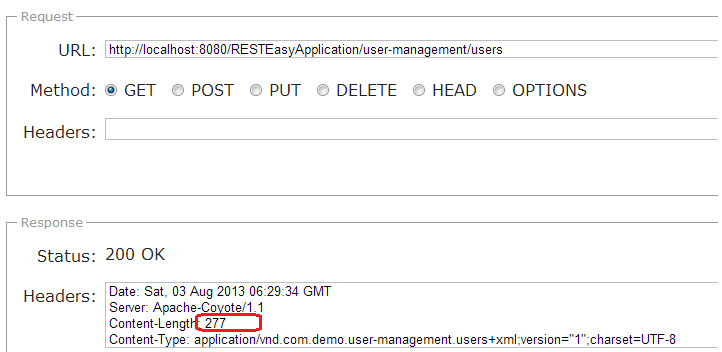
Example API output without gzip compression, when calling above GET REST API, will be as follows:
	Date: Sat, 03 Aug 2013 06:18:41 GMT
	Server: Apache-Coyote/1.1
	Content-Length: 277
	Content-Type: application/vnd.com.demo.user-management.users+xml;version="1";charset=UTF-8
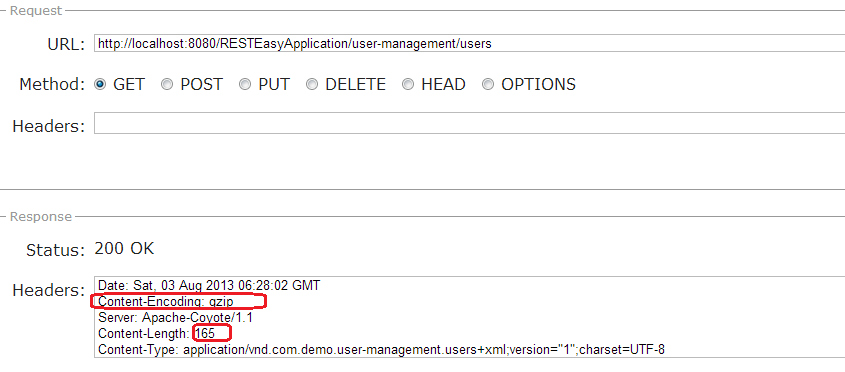
Example API output with gzip compression using @GZIP annotation
Date: Sat, 03 Aug 2013 06:31:21 GMT
Content-Encoding: gzip
Server: Apache-Coyote/1.1
Content-Length: 165
Content-Type: application/vnd.com.demo.user-management.users+xml;version="1";charset=UTF-8
Drop me a comment, something is not clear from the post.
Happy Learning !!

Can you show me the actual response body?
Also, please give an example on how to send gzip data in the request.
give me source code for that
Hi Lokesh,
I did try the example above for my project (Restful Web services), but i was unable to find the compression working. Most of the tools that i have tested still showed the me ” Transfer-Encoding: chunked” . Was unable to find the content-encoding as “gzip” any where. Any help is highly appreciated.
Please let me know:
1) what all request headers you are sending in request?
2) Method type: i.e. GET or POST or else?
3) Are you getting response back?
If possible please provide which environment you are using?
I have created Java based web services using jersey framework. The method that i was trying was a simple get method transmitting in Json format. I do receive the response as expected but not as GZIP’ed data, when viewed in tools like poster, etc… i am able to see the following details :
Response:
status: 200 OK
Date: Tue, 15 Apr 2014 03:26:10 GMT
Server: Apache-Coyote/1.1
Transfer-Encoding: chunked
Content-Type: application/json
I am using eclipse as my dev env.
Thanks, Lokesh
For Jersey, you should be using:
<init-param>
<param-name>com.sun.jersey.spi.container.ContainerRequestFilters</param-name>
<param-value>com.sun.jersey.api.container.filter.GZIPContentEncodingFilter</param-value>
</init-param>
<init-param>
<param-name>com.sun.jersey.spi.container.ContainerResponseFilters</param-name>
<param-value>com.sun.jersey.api.container.filter.GZIPContentEncodingFilter</param-value>
</init-param>
Eureka!!! Great … thanks lokesh… I tried what u suggested and it works. But just one question – Due to the fix that i have included in my web.xml, any request and response will be in gzip format irrespective of the use of @GZIP annotation. Am I right?
Can you send the complete source code,it very useful for project development