
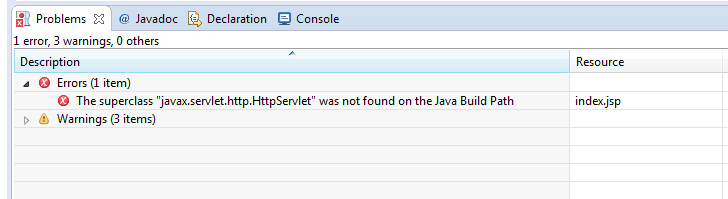
The Eclipse error The superclass “javax.servlet.http.HttpServlet” was not found on the Java Build Path means that the servlet API JAR is missing from the project build path, so Eclipse cannot compile a class that extends HttpServlet. The quickest fix is to add the servlet API as a provided Maven dependency, or to add the server runtime (such as Apache Tomcat) to the project.
We see this error mostly after importing an existing Maven web project into Eclipse, after creating a dynamic web project without a target runtime, or after moving a project from Tomcat 9 to Tomcat 10.1 or 11. In 2026, the first thing to check is the package name, because Tomcat 10.1 and 11 use jakarta.servlet, not javax.servlet.
The following example is a servlet for Tomcat 10.1 or 11 with the matching imports. It compiles once jakarta.servlet-api is on the build path.
import jakarta.servlet.http.HttpServlet;          // Servlet 6.x (Tomcat 10.1 and 11)
import jakarta.servlet.http.HttpServletRequest;
import jakarta.servlet.http.HttpServletResponse;
public class RecipeServlet extends HttpServlet { // compiles with jakarta.servlet-api 6.1.0
@Override
protected void doGet(HttpServletRequest req, HttpServletResponse resp) throws java.io.IOException {
resp.getWriter().write("Pancakes");
}
}<dependency>
<groupId>jakarta.servlet</groupId>
<artifactId>jakarta.servlet-api</artifactId>
<version>6.1.0</version>
<scope>provided</scope>
</dependency>Notice the provided scope, because the server already ships the servlet API at runtime. We go through both fixes in Eclipse, the choice between javax and jakarta for each Tomcat version, the same error on JSP files, and what to check when the red marker stays.
1. Why HttpServlet Is Not Found on the Build Path
Every servlet extends HttpServlet, and that class is not part of the JDK. It comes from the servlet API, which the servlet container (Tomcat, Jetty, WildFly) provides. A plain Java project in Eclipse has only the JDK on its build path, so the compiler marks the class declaration with this error and refuses to build it.
The same project compiled on the command line gives a clearer message. With only jakarta.servlet-api on the class path, a servlet that still imports javax.servlet fails on JDK 25 like this.
RecipeServlet.java:3: error: package javax.servlet.http does not exist
import javax.servlet.http.HttpServlet;
                         ^
RecipeServlet.java:5: error: cannot find symbol
public class RecipeServlet extends HttpServlet {
                                   ^
  symbol: class HttpServlet
2 errors
So the error has two common causes. Either the servlet API JAR is not on the build path at all, or the JAR is there but has a different package name (jakarta) than the imports in our code (javax).
2. Solution
To include the servlet API in the build path, we have two options. A Maven or Gradle project should declare the dependency, because the build works the same way in Eclipse, IntelliJ IDEA and on the CI server. A dynamic web project without a build tool gets the API from the server runtime.
2.1. Add the Target Server Runtime
In this solution, we add the server runtime to the project as a targeted runtime. The server runtime already contains the servlet and JSP API JARs, so Eclipse puts them on the build path and the error goes away. Follow these steps in Eclipse IDE for Enterprise Java and Web Developers.
- Open Window > Preferences > Server > Runtime Environments, click Add, pick Apache Tomcat v11.0 (or the version we deploy to) and point it to the Tomcat installation folder.
- Right-click the project and open Properties > Targeted Runtimes.
- Check the Tomcat runtime and click Apply and Close.
- If the error is still shown, open Properties > Project Facets, select the Runtimes tab and check the same runtime there.
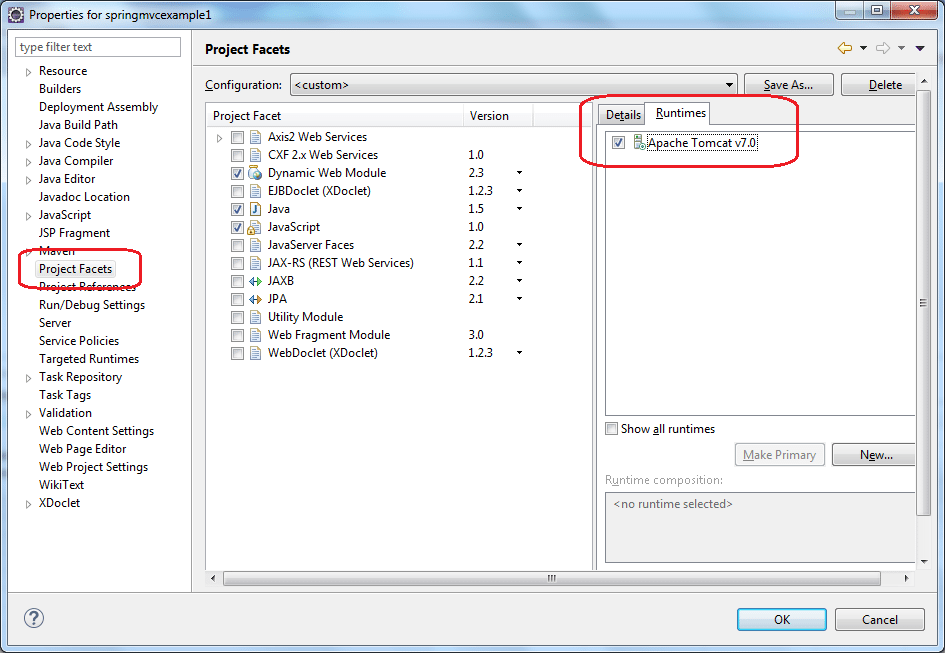
The targeted runtime is an Eclipse setting only. Maven and Gradle do not see it, so a build on the command line still fails until the project declares the dependency from the next section.
2.2. Add the Servlet API Maven Dependency
Another option is to add the servlet API dependency to pom.xml. The artifact depends on the server we deploy to, as listed on the Tomcat version page. For Tomcat 11, Jakarta EE 11 servers and Spring Boot 4, we use jakarta.servlet-api 6.1.0, as in the intro. For Tomcat 10.1 and other Jakarta EE 10 servers, we use 6.0.0.
<dependency>
    <groupId>jakarta.servlet</groupId>
    <artifactId>jakarta.servlet-api</artifactId>
    <version>6.0.0</version>
    <scope>provided</scope>
</dependency>
Only projects that still run on Tomcat 9 or another Java EE 8 server use the old javax artifact. Its last version is 4.0.1, and it keeps the javax.servlet package names.
<dependency>
    <groupId>javax.servlet</groupId>
    <artifactId>javax.servlet-api</artifactId>
    <version>4.0.1</version>
    <scope>provided</scope>
</dependency>
After saving pom.xml, right-click the project and select Maven > Update Project (Alt+F5), so Eclipse reloads the dependencies. There is no mvn update command. On the command line, mvn clean package downloads the JAR and compiles the project.
Keep the scope provided, because a servlet API JAR inside WEB-INF/lib clashes with the copy that the server already has. Tomcat always loads the Servlet, JSP, EL and WebSocket API classes from its own lib folder first, so the duplicate JAR adds nothing there and can cause class loading errors on other servers.
2.3. Add the Dependency in Gradle
Gradle has no provided scope. The compileOnly configuration does the same job, because it puts the JAR on the compile class path and leaves it out of the WAR file. After the change, right-click the project and select Gradle > Refresh Gradle Project.
dependencies {
    compileOnly 'jakarta.servlet:jakarta.servlet-api:6.1.0'
}
The war plugin also offers providedCompile, which works the same way for WAR projects.
3. javax or jakarta? Matching the Servlet API to the Server
Java EE moved to the Eclipse Foundation and became Jakarta EE. Since Servlet 5.0, every package starts with jakarta instead of javax, so javax.servlet.http.HttpServlet became jakarta.servlet.http.HttpServlet. The class is the same, but the JVM treats the two names as unrelated types.
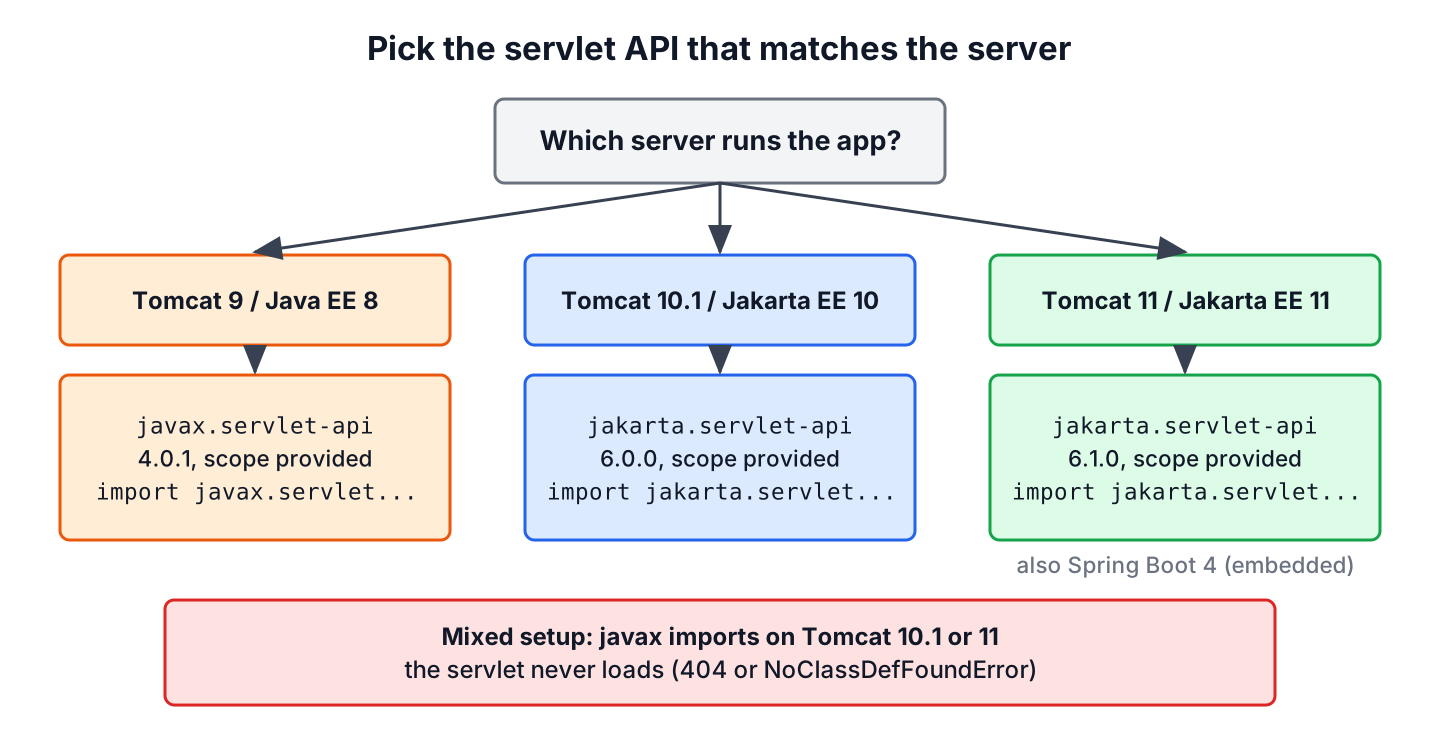
The server decides which name our code must use. The versions come from the Apache Tomcat version table and the Jakarta Servlet 6.1 specification.
| Server | Servlet version | Maven artifact | Package in imports |
|---|---|---|---|
| Tomcat 9.0 (Java EE 8) | 4.0 | javax.servlet:javax.servlet-api:4.0.1 | javax.servlet |
| Tomcat 10.1 (Jakarta EE 10) | 6.0 | jakarta.servlet:jakarta.servlet-api:6.0.0 | jakarta.servlet |
| Tomcat 11.0 (Jakarta EE 11) | 6.1 | jakarta.servlet:jakarta.servlet-api:6.1.0 | jakarta.servlet |
| Spring Boot 4 (embedded Tomcat 11) | 6.1 | none, it comes with spring-boot-starter-webmvc | jakarta.servlet |
A mixed setup is the trap. Code with javax imports compiles against javax.servlet-api, but Tomcat 10.1 and 11 ignore a javax @WebServlet annotation, so the URL returns 404. A servlet declared in web.xml fails to load with NoClassDefFoundError: javax/servlet/http/HttpServlet. The fix is to change the imports to jakarta and the dependency to jakarta.servlet-api, or to convert an old WAR with the Apache Tomcat migration tool for Jakarta EE.
For example, a team imports a 2019 order-tracking project with javax imports into a current Eclipse release and adds Tomcat 11 as the runtime. Every servlet shows the build path error, because Tomcat 11 provides only jakarta.servlet. Adding javax.servlet-api removes the red markers, but the pages return 404 after deployment. The real fix is a search-and-replace of javax.servlet with jakarta.servlet in the sources and in web.xml, plus the 6.1.0 dependency.
4. The Same Error on JSP Files
Eclipse also shows the message on JSP files, even when the project has no servlet class at all. The JSP validator translates each page into a servlet that extends HttpServlet, so it needs the same API on the build path. The JSP API (jakarta.servlet.jsp-api) is a separate JAR.
A server runtime from section 2 brings both JARs. With Maven, we add the JSP API next to the servlet API, again with provided scope. Version 4.0.0 matches Tomcat 11, and 3.1.1 matches Tomcat 10.1.
<dependency>
    <groupId>jakarta.servlet.jsp</groupId>
    <artifactId>jakarta.servlet.jsp-api</artifactId>
    <version>4.0.0</version>
    <scope>provided</scope>
</dependency>
5. When the Error Stays After the Fix
Eclipse caches the build path and the validation results, so the marker sometimes survives a correct fix. Go through these checks in order.
- Run Maven > Update Project and check Force Update of Snapshots/Releases if a download failed earlier.
- Run Project > Clean to rebuild the project and refresh the markers in the Problems view.
- Open Properties > Java Build Path > Libraries and confirm that Maven Dependencies or the server runtime library is listed.
- Search the sources for import javax.servlet when the server is Tomcat 10.1 or 11.
- Delete a broken JAR from the local Maven repository (~/.m2/repository/jakarta/servlet) and update the project again.
A related compile error, HttpServlet cannot be resolved to a type, has the same causes and the same fixes. The guide to creating a Maven web project in Eclipse shows a clean project setup from the start.
6. HttpServlet Build Path FAQs
The fix changes a little with Spring Boot, with IntelliJ IDEA and in projects without a build tool, and the provided scope needs its own explanation.
6.1. Why does the servlet API dependency use provided scope?
Because the server supplies the servlet API at runtime. The provided scope puts the JAR on the compile class path and keeps it out of the WAR file. The Maven dependency scopes guide compares all scopes.
6.2. Does a Spring Boot application need the servlet API dependency?
No. The spring-boot-starter-webmvc starter (named spring-boot-starter-web before Spring Boot 4) pulls in tomcat-embed-core, which contains the jakarta.servlet classes. We add jakarta.servlet-api as provided only when we deploy a Spring Boot WAR to an external Tomcat and the starter Tomcat is marked provided too.
6.3. How do I fix the same error in IntelliJ IDEA?
IntelliJ IDEA reads the dependencies from pom.xml or build.gradle, so we add jakarta.servlet-api as shown in section 2 and click Reload All Maven Projects. For a project without a build tool, we add the Tomcat lib/servlet-api.jar under File > Project Structure > Modules > Dependencies.
6.4. Can I add the servlet-api.jar from the Tomcat lib folder by hand?
Yes, it works for a quick test, because servlet-api.jar in TOMCAT_HOME/lib contains HttpServlet. It ties the project to one folder on one machine, so a Maven dependency or a targeted runtime is the better long-term fix.
7. Conclusion
Eclipse shows The superclass “javax.servlet.http.HttpServlet” was not found on the Java Build Path whenever the project has no servlet API on its build path. We fix it with a provided dependency on the servlet API, or with a targeted server runtime for projects without a build tool.
The package name matters as much as the JAR. Tomcat 10.1, Tomcat 11 and Spring Boot 4 need jakarta.servlet imports with jakarta.servlet-api 6.0.0 or 6.1.0, while only Tomcat 9 projects keep javax.servlet-api 4.0.1. For more on servlets, read the Java servlets tutorial, and the guide to checked and unchecked exceptions shows where errors such as NoClassDefFoundError sit in the Throwable hierarchy.
8. References
- Apache Tomcat, Which Version Do I Want?
- Jakarta Servlet 6.1 Specification
- Eclipse Help, Specifying Target Servers
- Maven, Dependency Scope
- Apache Tomcat 10 Migration Guide
Happy Learning !!

After that don’t forget to perform two operations: Maven update and maven install.
Worked like charm ;)
Thank youuuuuuuuuuuuu it worked for me!
It Worked but after using this solution my tomcat server is not working.
Thank so much! It worked!
thank you so much it worked for me
I tried this but did not work. do we have any other solution?
Thank you. worked for me.
Thanks for this tutorial. Saved my day!
Thank you very much.
thankyu so much man..
Thanks !
Thanks Lokesh………….
What is the difference between the two solutions?
Thanks a lot man !!!!
Thanks man Solved my problem
Thanks for Posting this solution. It worked for me.
27-Jan-2016 12:17:06.629 SEVERE [http-nio-8080-exec-13] org.apache.coyote.http11.AbstractHttp11Processor.process Error processing request
java.lang.IllegalStateException: The resources may not be accessed if they are not currently started
at org.apache.catalina.webresources.StandardRoot.validate(StandardRoot.java:232)
at org.apache.catalina.webresources.StandardRoot.getResource(StandardRoot.java:199)
at org.apache.catalina.webresources.StandardRoot.getResource(StandardRoot.java:193)
at org.apache.catalina.mapper.Mapper.internalMapWrapper(Mapper.java:918)
at org.apache.catalina.mapper.Mapper.internalMap(Mapper.java:808)
at org.apache.catalina.mapper.Mapper.map(Mapper.java:667)
at org.apache.catalina.connector.CoyoteAdapter.postParseRequest(CoyoteAdapter.java:862)
at org.apache.catalina.connector.CoyoteAdapter.service(CoyoteAdapter.java:521)
at org.apache.coyote.http11.AbstractHttp11Processor.process(AbstractHttp11Processor.java:1078)
at org.apache.coyote.AbstractProtocol$AbstractConnectionHandler.process(AbstractProtocol.java:655)
at org.apache.coyote.http11.Http11NioProtocol$Http11ConnectionHandler.process(Http11NioProtocol.java:222)
at org.apache.tomcat.util.net.NioEndpoint$SocketProcessor.doRun(NioEndpoint.java:1566)
at org.apache.tomcat.util.net.NioEndpoint$SocketProcessor.run(NioEndpoint.java:1523)
at java.util.concurrent.ThreadPoolExecutor.runWorker(Unknown Source)
at java.util.concurrent.ThreadPoolExecutor$Worker.run(Unknown Source)
at org.apache.tomcat.util.threads.TaskThread$WrappingRunnable.run(TaskThread.java:61)
at java.lang.Thread.run(Unknown Source)
When you get this error?
After configure whole project in eclipse, i included >javax.servlet dependency. Then found the above error with code 500 on UI- Network.
Great Man. Problem resolved.
Thanks for the solution to the problem “The superclass “javax.servlet.http.HttpServlet” was not found on the Java Build Path in Eclipse”
Glad it was useful for you.