Spring Bean Life Cycle: Callbacks, Order and Diagram
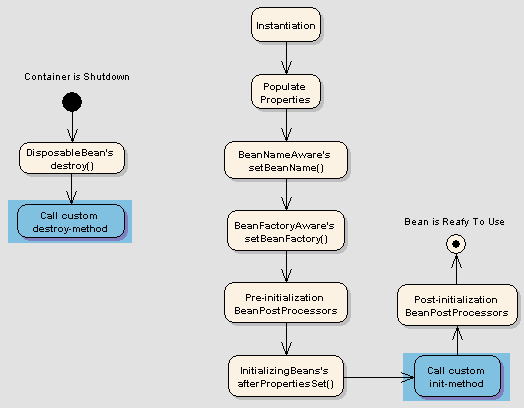
The Spring bean life cycle is the fixed order in which Spring creates a bean, injects its dependencies, runs its init callbacks and, when the context closes, its destroy callbacks.

The Spring bean life cycle is the fixed order in which Spring creates a bean, injects its dependencies, runs its init callbacks and, when the context closes, its destroy callbacks.
Spring Framework 7 keeps Java 17 but moves to Jakarta EE 11, JSpecify null-safety and Jackson 3. This overview lists every notable change in a summary table and shows the main new features, such as @Retryable, API versioning and BeanRegistrar, with short examples.
Spring lookup method injection is the container’s ability to override methods on container-managed beans and return another container-managed bean.
Spring context supports singleton and prototype bean scopes along with four other scopes specific to the web context. The singleton is the default bean scope. A common problem arises when we want to inject a prototype-scoped bean into a singleton-scoped bean. In this case, as the singleton bean is initialized …
Learn about the most widely used spring annotations. In this tutorial, we will briefly cover the important annotations which are provided by spring core to define beans and create complex application context configurations. 1. Annotations in Spring Framework Similar to other places, annotations help by providing metadata and instructions to …
Learn to create and receive publisher-subscriber-style native events in a Spring application using @EventListener and @RecordApplicationEvents annotations.
Show text in the user’s language with Spring’s ResourceBundleMessageSource and one messages.properties file per language. Learn getMessage() with arguments, the order in which Spring checks the files, UTF-8, missing keys and the Spring Boot setup.
Spring BeanPostProcessor allows for custom modification of new bean instances created by spring bean factory. Spring AOP classes use bean post-processors
Learn different ways to load resources or files (e.g. text files, XML files, properties files, or image files) into the Spring application context. Spring ResourceLoader provides a unified getResource() method to retrieve an external resource by the resource path. 1. Spring Resource Interface The Spring Resource is a general interface …
In Spring framework, if you want to create a bean by invoking a static factory-method, whose purpose is to encapsulate the object-creation process in a static method then you could use factory-method attribute. Read More : Spring FactoryBean Static factory method example If you want to create different EmployeeDTO objects …
In Spring, FactoryBean creates beans that cannot be created using the ‘new’ keyword and involve complex initialization or configuration.
Learn about spring bean stereotype annotations i.e. @Controller, @Component, @Repository and @Service, their real-life usages and examples.
Learn to fix the ContextLoaderListener class not found error that is present used in a web application and is part of the spring-web module.
Spring send email program for explaing the usage of javamailsender interface of javax.mail dependency. Send email example in Java using Spring framework.
Spring autowiring finds a matching bean by type and injects it. Learn how Spring picks between several beans with @Qualifier, @Primary and @Fallback, how to declare optional dependencies, and what breaks with circular dependencies.
Spring bean autowiring “byConstructor” is the recommended approach and injects dependencies into a bean by utilizing its constructor.
In Spring Framework, autowiring by name is a feature that allows developers to inject dependencies into a bean by matching the property name with the name of the target bean. This is achieved using the @Autowired annotation (Java Configuration) along with the byName attribute (XML Configuration). 1. What is Autowiring …
Bean autowiring by Type instructs the Spring IoC container to inject a bean of the same type as the property into which it is being injected.
The Spring bean life cycle runs from instantiation and dependency injection to the init callbacks and, at shutdown, the destroy callbacks. See the exact callback order in a Spring Boot app with real output, plus the Aware interfaces, XML config and the shutdown hook.
The beans in Spring or Spring Boot can be created in six different scopes: singleton, prototype, request, session, application and websocket.
Timer is a utility class which is used to schedule tasks for both one time and repeated execution in spring applications. Timer is dependent on system clock
Learn about Spring IoC container, how it has been implemented using ApplicationContext, creating it programmatically and accessing the beans.
In Spring, our classes do not create their objects with new. Spring creates the objects and hands them over. IoC is the name of this idea, and DI is how Spring hands the objects over. Includes BeanFactory vs ApplicationContext, constructor, setter and field injection, @Primary and @Qualifier, and a tested example in plain Spring and Spring Boot.
Spring @ExceptionHandler methods handle exceptions in one controller, and the same methods in a @ControllerAdvice class handle them for every controller. Learn the difference, return ProblemDetail (RFC 9457) bodies, handle validation errors and @ResponseStatus, and test each handler with MockMvc on Spring Boot 4.
In this Spring tutorial, we will learn to use spring mvc interceptor in spring mvc applications. This tutorial is very short to focus only on spring interceptor configuration and usage. Interceptors, as we know, are special web programming constructs which gets invoked every time when a certain pre-configured web request …
Spring @Configuration annotation example. @Configuration annotation helps in Spring annotation based configuration. It is also called Spring Java Config.
HowToDoInJava provides tutorials and how-to guides on Java and related technologies.
It also shares the best practices, algorithms & solutions and frequently asked interview questions.