
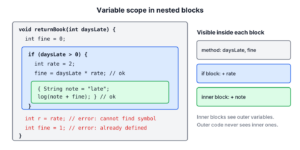
A block statement in Java is a sequence of zero or more statements enclosed in braces, and Java treats the whole block as one statement. Every variable declared inside a block exists only until the closing brace.
We use block statements to group several statements wherever the syntax allows only one, such as the body of an if or a loop, and to keep temporary variables out of the rest of a method.
The following example uses a block as the body of an if statement in a library app, so both statements run only when a copy is available.
int copies = 2;
String status = "Waitlisted";
if (copies > 0) {                       // block starts
    copies--;
    status = "Checked out";
}                                       // block ends
int left = copies;                      // 1
String shown = status;                  // "Checked out"
Notice that the if controls one statement, and the braces turn two statements into that one. The next sections show where blocks appear, why braces matter even for a single line, how blocks limit variable scope, and which initializer and labeled blocks exist outside ordinary statements.
1. What Is a Block Statement?
A block is a pair of braces around a list of block statements, which are statements, local variable declarations and local class, record, enum or interface declarations. An empty pair of braces is also a valid block. Java runs the statements of a block in order, from top to bottom, unless a statement such as return, break or throw ends the block early.
Blocks are everywhere in Java code, even where we do not call them by that name. The braces of a class body and of an array initializer such as {1, 2, 3} are not blocks, because they cannot contain statements.
| Where the block appears | Example |
|---|---|
| Method and constructor bodies | void checkout() { … } |
| Branches of if and else | if (late) { … } else { … } |
| Loop bodies | for (Book b : shelf) { … } |
| try, catch and finally | try { … } catch (IOException e) { … } |
| Arrow cases of switch | case 1 -> { … } |
| Lambda bodies | book -> { … } |
| Initializer blocks in a class | static { … } and { … } |
| A standalone block inside a method | { int temp = 5; … } |
A block is one of several kinds of statements, next to expression statements, declarations and control flow statements, which the types of statements in Java article compares.
2. Why Braces Matter for Single Statements
The if, else, for, while and do statements each control only one statement. Without braces, that is only the next statement, and the indentation of the following lines has no effect.
Say the library charges a fine for late returns and sends a notice at the same time. A developer adds the notice as a second indented line under an if without braces, and the notice goes out for every return, including books returned on time.
int daysLate = 0;
int fine = 0;
boolean notified = false;
if (daysLate > 0)
    fine = daysLate * 2;
    notified = true;                    // runs always, despite the indentation
boolean sent = notified;                // true
int daysLate = 0;
int fine = 0;
boolean notified = false;
if (daysLate > 0) {
fine = daysLate * 2;
notified = true;
}
boolean sent = notified; // falseWe put braces around the body of every if, else and loop, even when it has a single statement, so a line added later cannot fall outside the condition. Most style guides, including the Google Java Style Guide, require braces for that reason.
A stray semicolon causes a related bug. A ; right after the condition is an empty statement, so the if ends there and the block after it becomes a standalone block that always runs.
int daysOverdue = 0;
boolean blocked = false;
if (daysOverdue > 30);                  // the semicolon ends the if
{
    blocked = true;                     // standalone block, always runs
}
boolean result = blocked;               // true
3. Variable Scope Inside Blocks
A local variable declared in a block is in scope from its declaration to the closing brace of that block. Code inside nested blocks can use variables of the enclosing blocks, but code outside a block cannot see the variables declared inside it.
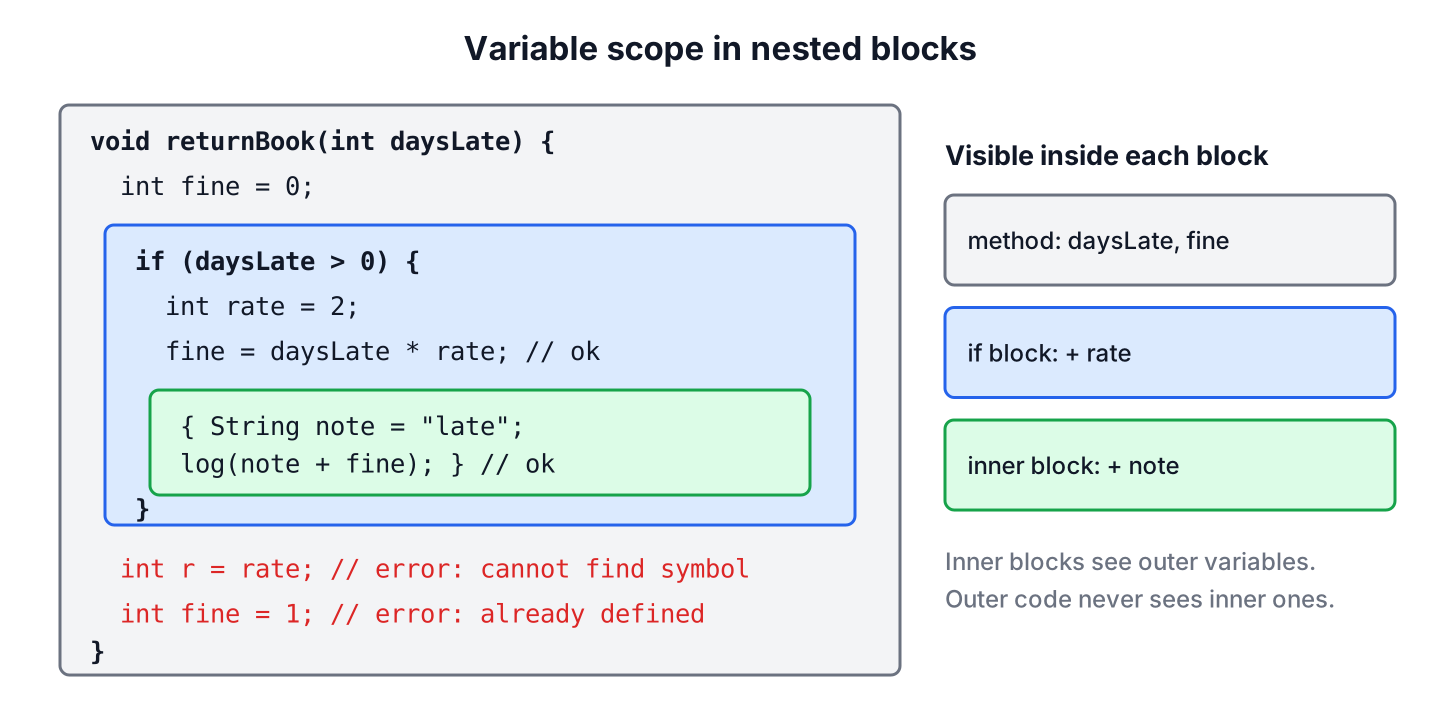
// does not compile: cannot find symbol due
{
    int due = 14;
}
int days = due;
Java adds one more rule that C and JavaScript do not have. A local variable cannot be redeclared in a nested block while the outer variable is still in scope, so the compiler rejects an inner variable that would hide an outer one.
// does not compile: variable fine is already defined in method
int fine = 0;
{
    int fine = 5;
}
Two sibling blocks, one after the other, can reuse the same name, because the first variable is out of scope when the second block starts. We use a standalone block in a long method to keep a temporary variable from leaking into the rest of the code.
int total = 0;
{
    int fee = 2;
    total += fee;
}
{
    int fee = 3;                        // allowed, the first fee is out of scope
    total += fee;
}
int charged = total;                    // 5
A field is a different case. A local variable or parameter with the same name as a field is allowed and hides the field inside the block, which is why constructors write this.name = name. The Java variables article covers scope and lifetime for every kind of variable.
4. Static and Instance Initializer Blocks
A block placed in a class body, outside any method, is an initializer block. A static initializer, written static { … }, runs once when the class is initialized, which happens on the first use of the class, such as creating an object or reading a static field, and not when the class file is loaded. An instance initializer, written as a plain block, runs every time an object is created, right after the superclass constructor call and before the rest of the constructor body.
The following example records the order of execution in a catalog class that loads its starting stock in a static block.
class Catalog {
    static final List<String> LOG = new ArrayList<>();
    static int books;

    static {
        books = 100;
        LOG.add("static block");
    }

    {
        LOG.add("instance block");
    }

    Catalog() {
        LOG.add("constructor");
    }
}
new Catalog();
new Catalog();
List<String> order = Catalog.LOG; // [static block, instance block, constructor, instance block, constructor]
int stock = Catalog.books; // 100We can see that the static block ran once, while the instance block ran before each constructor. In new code, we prefer a static method or a field initializer over a long static block, and constructors over instance initializers, because both are easier to test and to read. An exception thrown in a static block makes the class unusable with an ExceptionInInitializerError.
5. Labeled Blocks With break
A block can carry a label, and break label; inside it jumps to the end of that block. This is rarely needed, but it gives a clean exit from a search with nested loops or several steps, without a flag variable. The labeled statements article shows labels on loops as well.
List<String> shelf = List.of("Dune", "Emma", "Ulysses");
String wanted = "Emma";
String message;
search: {
    for (String title : shelf) {
        if (title.equals(wanted)) {
            message = "found " + title;
            break search;
        }
    }
    message = "ask the librarian";      // skipped when break search runs
}
String result = message;                // "found Emma"
In most code, moving the search into a method that returns the result is clearer than a labeled block, so we keep labels for the few cases where a method would need many parameters.
6. Block Statement FAQs
Beginners ask about empty braces and nested declarations, and reviewers ask about style and performance.
6.1. Can a block be empty in Java?
Yes. An empty block {} is a valid statement that does nothing. It shows up as an empty catch block or a method stub, and in both cases a comment that explains why it is empty helps the next reader.
6.2. Can we declare a class or record inside a block?
Yes. A local class can be declared in any block, and since Java 16, local records, enums and interfaces are allowed as well. They are visible only inside the block.
List<String> titles = List.of("Dune", "Emma");
record Loan(String title, int days) {}
Loan loan = new Loan(titles.get(0), 14);
String borrowed = loan.title();         // "Dune"
6.3. Do extra braces make Java code slower?
No. Scope is a compile-time concept. The compiler only uses the braces to decide where each name is valid, and the bytecode contains no instructions for entering or leaving a block. The compiler can even reuse the local variable slot of a variable that went out of scope.
6.4. Is a method body a block statement?
Yes, a method or constructor body is a block. It follows the same scope rules, and its parameters are in scope for the whole body. A lambda with braces, such as x -> { return x * 2; }, also has a block as its body.
7. Conclusion
A block statement groups zero or more statements in braces so Java can treat them as one, which is how if, loops, try and lambdas get multi-line bodies. Braces on every branch prevent the classic bug where an added line falls outside its condition, and a stray semicolon after a condition turns the following block into code that always runs.
Each block also limits the scope of its local variables, and Java forbids redeclaring an outer local variable in an inner block. Outside methods, static initializer blocks run once when the class is initialized, and instance initializer blocks run on every object creation, right after the superclass constructor call. Blocks are the building unit of every control flow statement in the Java tutorial.
8. References
- JLS 25, Blocks
- JLS 25, Scope of a Declaration
- JLS 25, When Initialization Occurs
- Oracle Java Tutorials, Expressions, Statements, and Blocks
- Google Java Style Guide, Braces
Happy Learning !!
