How to Extract Data From Invoices With AI in Python
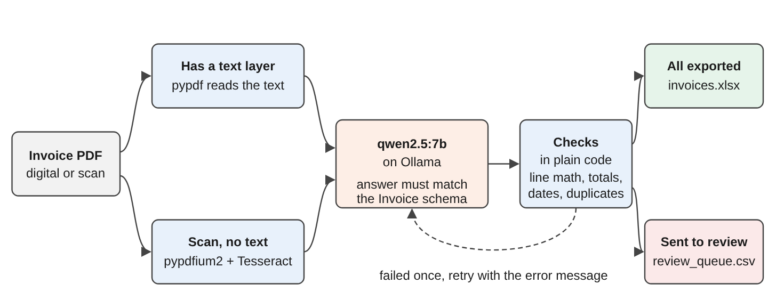
Learn how to extract data from invoices with AI in Python using a local Ollama model, Pydantic, OCR and checks, with accuracy measured on 24 invoices.

Artificial Intelligence (AI) refers to the development of computer systems that can perform tasks that typically require human intelligence. These tasks include learning, reasoning, problem-solving, perception, language understanding, and even interaction with the environment.
AI aims to create machines or software that can mimic or simulate human intelligence to execute tasks autonomously.
How to Reduce Claude Code Costs Without Losing Quality explains how to keep project instructions focused, write clear requests, manage conversation history, and compare costs while checking the results.
Learn how to extract data from invoices with AI in Python using a local Ollama model, Pydantic, OCR and checks, with accuracy measured on 24 invoices.
Screen resumes with AI in Python. Redact names, check each requirement with a local Ollama model, verify every quote, and leave the decision to a human.
Find root cause of errors in logs with AI. Group logs with Drain3, mask secrets, ask a local Ollama model for ranked causes, and check every cited line.
In multi-agent AI system, each agent has its own instructions and a specific part of the task to complete. The agents can use the same language model.
Compare Spring AI, LangChain4j, Embabel, and AgentScope Java with the same ticket-lookup example. Choose a starting framework for Spring Boot, plain Java, or agents that need planning.
Reduce Claude Code costs with measured changes to CLAUDE.md, prompts, subagents and sessions, tested on a Spring Boot project with a passing test suite.
Prompt injection in LLM apps explained: direct and indirect attacks run against a Python assistant, five defenses, and the attack counts after each.
Fine tuning vs RAG vs prompt engineering for LLM apps: what each changes, cost and data needed, a Java prompt example, and a flow to pick one.
Run LLMs locally from Java with Ollama, Docker Model Runner or LM Studio: compare the three, then call any of them with one plain Java HttpClient class.
Retrieval augmented generation (RAG) explained for Java developers: index, retrieve, generate, the key terms, a runnable offline example and the trap.
MCP tool poisoning hides instructions in a tool description. See it demonstrated in Python, with hash pinning, scanning and sandboxing as defenses.
Context bloat is the growth of an LLM request with tokens the model does not need. Measure a real agent request and cut it with six techniques.
Stateless MCP means every request carries what the server needs. What revision 2026-07-28 removed and added, shown with a stateful and a stateless Python server behind a two-instance proxy.
A SKILL.md file holds on-demand instructions for a coding agent. This guide covers the format, the description that triggers it, a validator and two tests.
Compare ten machine learning libraries for Java by version, license, minimum Java and maintenance status, with Smile and Tribuo examples and a pick-by-situation table.
Estimate LLM token costs in Java with current OpenAI, Anthropic and Gemini prices, read real token usage with Spring AI, and cut the bill with prompt caching.
Learn what the Model Context Protocol (MCP) is, how hosts, clients and servers exchange JSON-RPC messages, and how to build an MCP server and client in Java.
LLM terms for Java developers, from tokens and context windows to temperature, embeddings, RAG, tool calling and MCP, with Spring AI classes.
In this chatGPT tutorial, explore the entire life cycle of fine-tuning models from preparing training data, creating a fine-tuned model, and using it programmatically.
Learn the basics of ChatGPT, the ChatGPT API for Python, and how to use it for creating and performing NLP tasks with examples.
HowToDoInJava provides tutorials and how-to guides on Java and related technologies.
It also shares the best practices, algorithms & solutions and frequently asked interview questions.